Triumph TR8 Versions
Two bodies, three plants and two fuel systems: the coupés of Speke and Canley, the convertibles of the 1979 to 1981 model years and the last Canadian cars, and the right-hand-drive cars built for a British launch that never came.
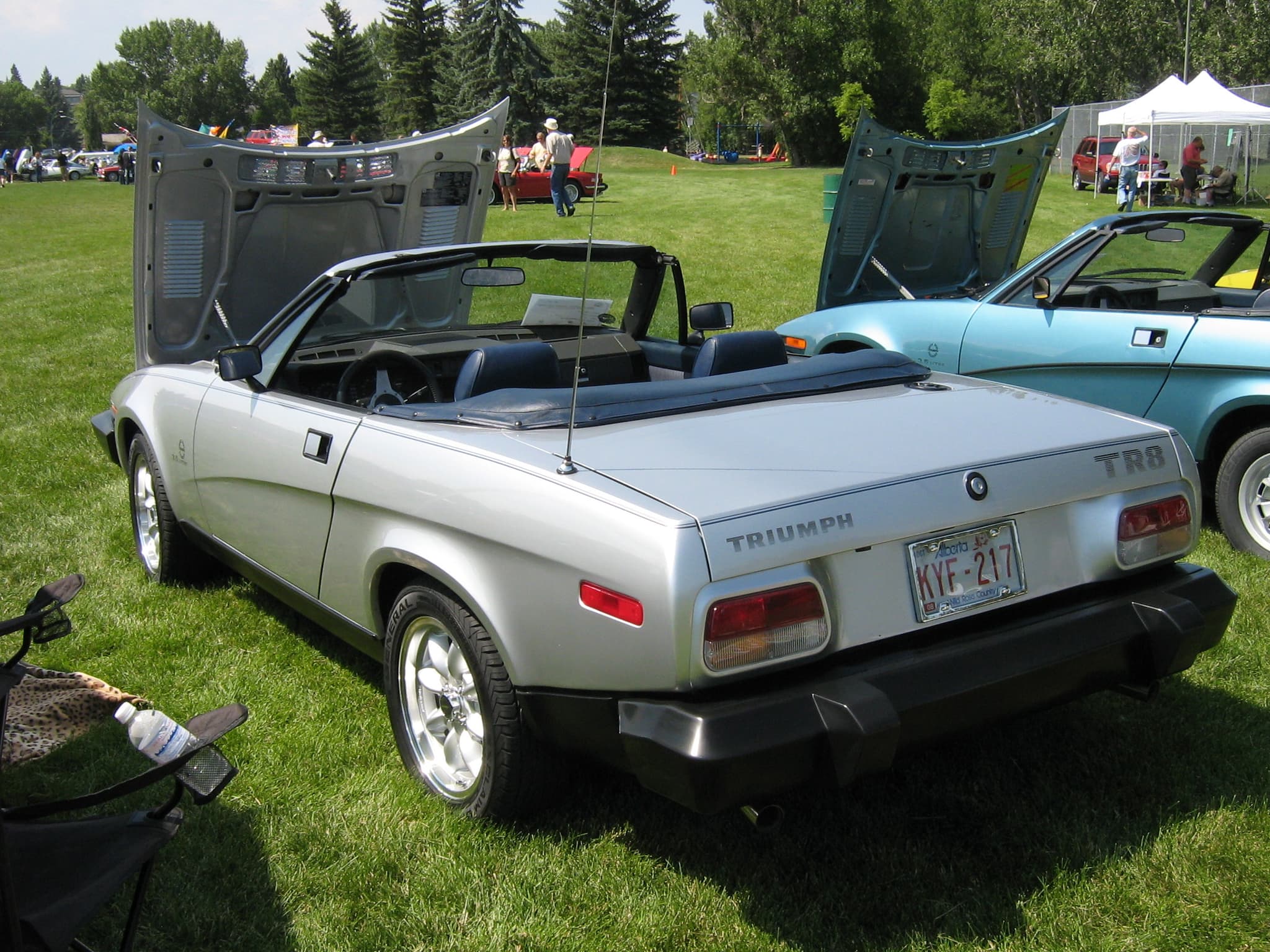
Almost every TR8 is a convertible. A small number of coupés came first, built at Speke in 1977 and at Canley in 1978 and 1979, and they are on the coupé's page. The convertible followed for the 1979 model year and was the TR8 America bought, with carburettors in 49 states and fuel injection in California in the 1980 model year, and injection everywhere in the 1981 model year. Canadian dealers advertised the last few as 1982 models. Britain was to have a right-hand-drive TR8 with carburettors, but it got no further than a pilot run.source 1source 2source 3source 4source 5source 6
The versions at a glance
| Version | Built | Plant | Chassis prefix | Fuel system |
|---|---|---|---|---|
| V8 Bullet prototypes | 1973 to 1977 | Experimental department | X numbers: X840, X843, X858, X859 | X840 had Bosch injection at first, then carburettors |
| Pre-production coupé | February to October 1977 | Speke | ACN | Carburettors; most with an automatic gearbox (transmission) |
| Coupé | 1978 and 1979 model years | Canley | TCN | Carburettors |
| First convertibles | 1979 model year | Canley | TCV | Carburettors |
| Convertible, 1980 model year | October 1979 to August 1980 | Canley | TPVDV (49 states), TPZDV (California), TPLDV (Canada) | Carburettors in 49 states, injection in California |
| Convertible, 1981 model year | May 1980 to October 1981 | Canley, then Solihull | TP, then SATP from May 1981 | Injection |
| Convertible, 1982 model year | August to October 1981 | Solihull | SATPL, with C for 1982 | Injection |
| Right-hand drive, for Britain | April 1980 to March 1981 | Canley and Solihull | TPADV7A (manual), TPADV3A (automatic) | Carburettors |
| Personal export, for Europe | 1980, and June to September 1981 | Solihull in 1981 | US federal numbers | Carburettors in 1980, injection in 1981 |
The 1982 row rests on an enthusiast site, tr8.com, and the prototypes' dates on triumphtr8.com's records of them. Every TR8 built for sale had Rover's V8, a five-speed manual or a three-speed Borg-Warner automatic gearbox, and its battery in the boot (trunk).
From the outside, the clues are the roof, the badges and the fuel system under the bonnet (hood). The engine number is a better guide than any badge: its prefix is 10E or 11E for a 49-state carburettor engine, 12E or 13E for a California carburettor engine, 14E or 15E for injection and 20E or 21E for the British cars, the second number of each pair marking an automatic. Identification explains the numbers in full.source 7source 1source 8source 9source 3source 4source 10source 5source 11source 12source 13
Model years
North American TR8s are known by model year:
| Model year | The cars | Fuel system | Notes |
|---|---|---|---|
| 1978 | The Speke coupés, issued to BL's staff in the United States and Canada as company cars | Carburettors | No badges; most automatic, Mike Cook writes |
| 1979 | Canley coupés, and the first convertibles | Carburettors | The TR Drivers Club notes that Cook's accounts mention no sales of 1979 models |
| 1980 | The convertible, and the Canley coupés | Carburettors in 49 states, injection in California | In the showrooms from the spring of 1980; Cook is quoted as saying the coupés were sold as 1980 models; the larger bonnet bulge from late in the 1979 model year |
| 1981 | The convertible | Injection in every state and in Canada | Cloth seats in place of plaid; a 17-character VIN with a check digit from May 1981 |
| 1982 | The convertible, in Canada only | Injection | Kilometre speedometers, according to tr8.com |
Production
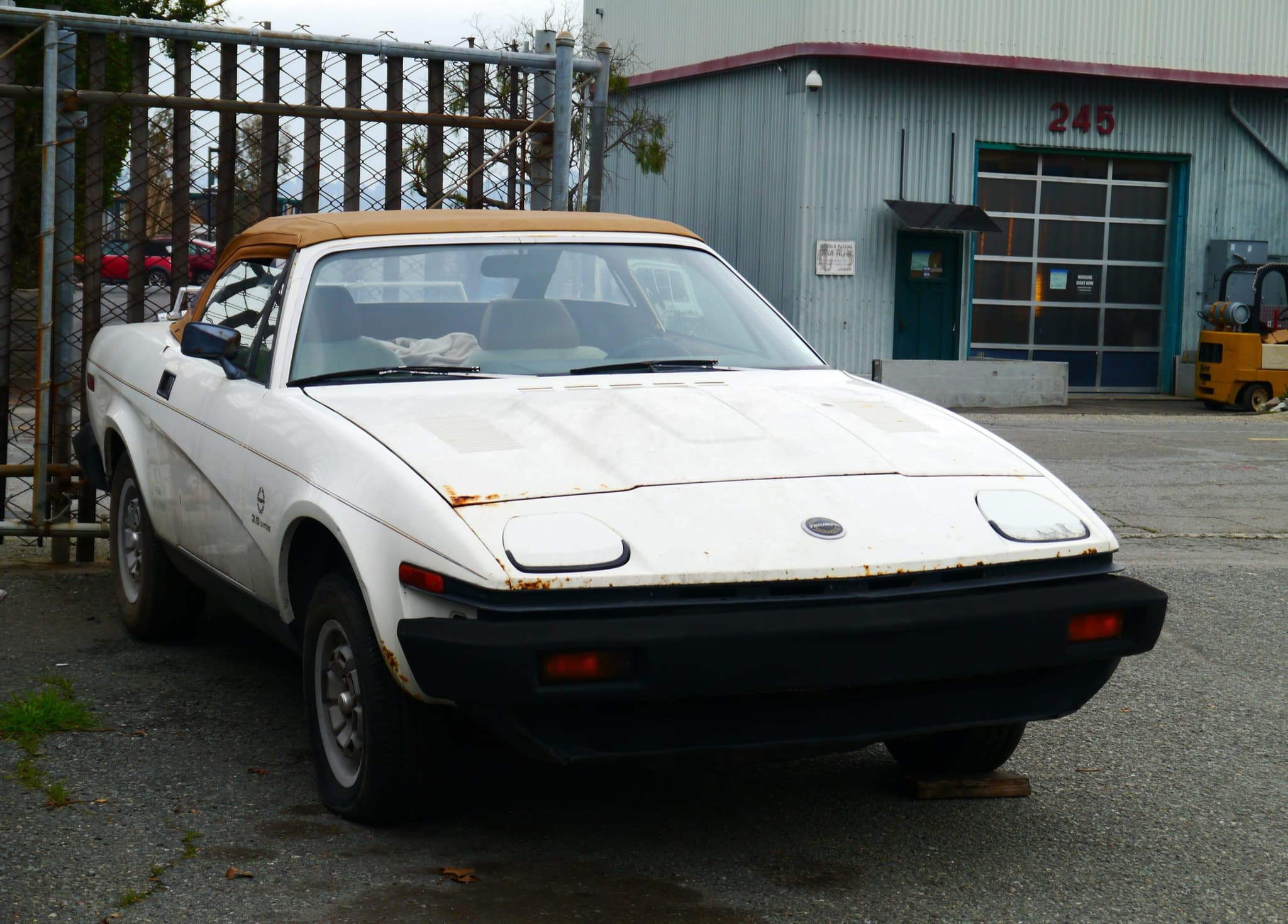
No single table counts every TR8. BL's own table counts by calendar year: coupés in 1979, then the cars of 1980 and 1981, under a heading for 1980 that reads "TR 8 FHC (DHC?)". The TR Drivers Club, which reproduces the table, says that row "should almost certainly be Convertibles", and warns that none of its figures is likely to include pre-production or prototype cars. The TR Drivers Club's batch table and triumphtr8.com's table count by batch and plant instead, and take in the Speke coupés.
The coupés are the hardest to count: BL's table counts those of 1979, other counts take in the Speke cars too, and the coupé's page compares them. No source read counts the injected cars: James TenCate estimated their number from the engine numbers and from the injection systems ordered from Lucas.
The line-up below gives the coupés' and the British cars' leading figures, and identification sets every count, the convertibles' among them, beside its source.source 1source 7source 15source 4source 8source 13
Markets
The TR8 was built for North America, and the differences between its markets were mostly in the fuel and the exhaust. In the 1980 model year the cars for 49 states had two Zenith-Stromberg carburettors with automatic chokes, air injection, exhaust-gas recirculation and oxidation catalysts. California's had Lucas/Bosch L-Jetronic injection and a three-way catalyst controlled by an oxygen sensor, and the California Air Resources Board certified that engine for the TR8 coupé, the TR8 convertible and the Rover 3500 on 18 March 1980. Road & Track gave the reason for two engines:
Triumph planners decided to use the different engines to keep the TR8's basic price down; injection is expensive.
Road & Track also said California would get no coupé. Michael Lamm recalled being told that Jaguar Rover Triumph expected to sell most of its early TR8s in California, and that the work of meeting the federal rules was done at Goodyear's test facility near Laredo, Texas. A year earlier, on 22 February 1979, the board had certified a carburettor TR8 for California for the 1979 model year, matching the 12E and 13E engine numbers, but no source read records one sold. For the 1981 model year every North American TR8 was injected, under a new certificate, and from May 1981 the chassis numbers grew to 17 characters, with a check digit. Every American TR8 had energy-absorbing bumpers front and rear and a front spoiler.
Canada had the TR8 from early in 1980, with the Rover 3500, and its cars carried their own letter, L, in the chassis number; no source read says whether its cars of the 1980 model year had carburettors or injection. The last cars sent there, built in the late summer of 1981, were sold as 1982 models with kilometre speedometers, tr8.com records.
Britain never had the TR8 on sale. The right-hand-drive cars built for a launch planned for 1981 had carburettors, higher compression and their chassis plate on the front suspension turret, and are on the right-hand-drive page. In Europe, American and Canadian service personnel and diplomats could buy a TR8 free of tax as a personal export, and triumphtr8.com describes these cars: built to the federal specification but without catalysts, the injected ones set to run on leaded fuel, with the larger leaded-fuel filler neck. The chassis-number system had letters for Australia and Japan too, but no source read documents a TR8 for either market.source 16source 17source 3source 14source 1source 4source 6source 10source 11source 18source 19source 20source 21source 12source 22
Colours and trim
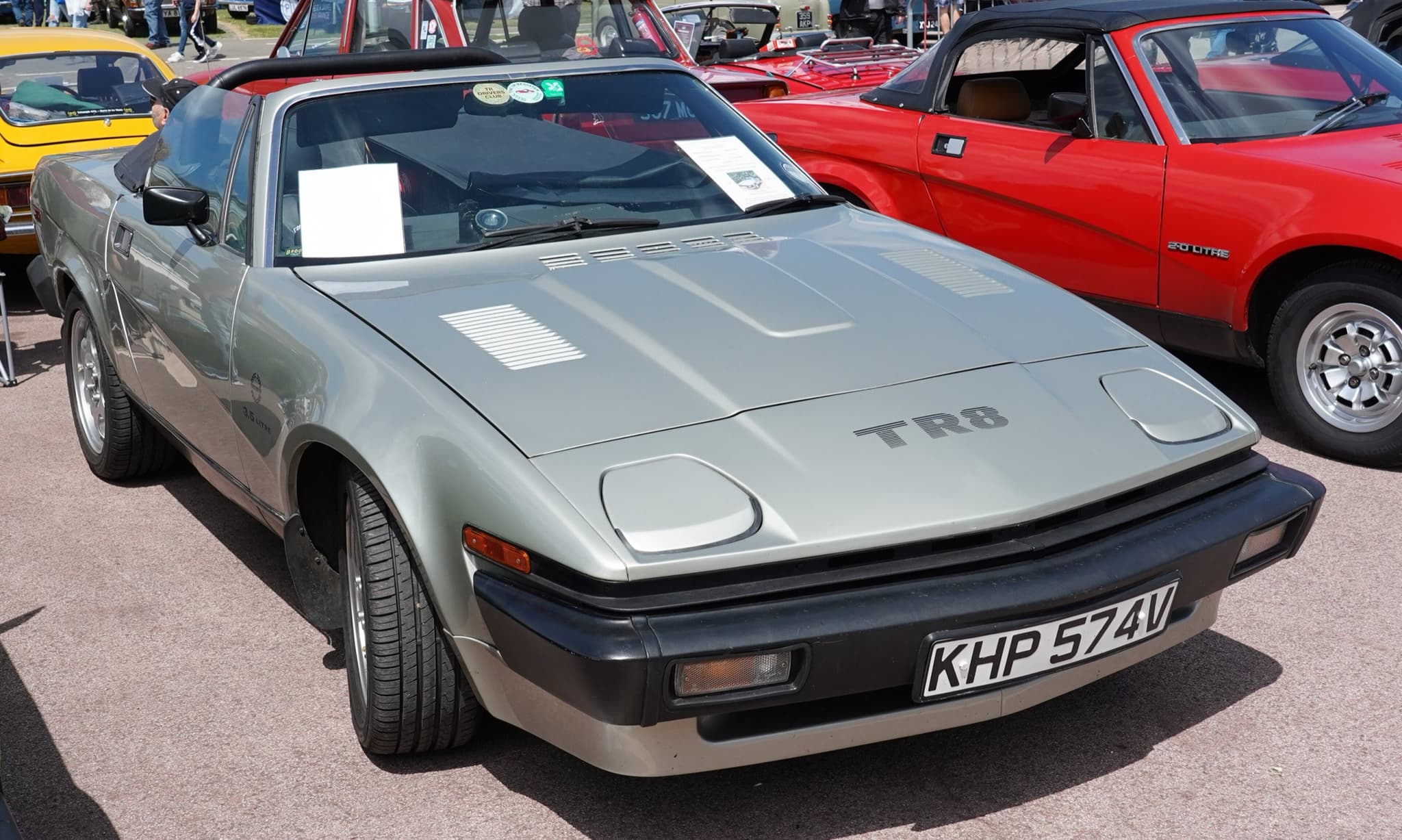
The 1977 coupé brochure for America listed nine colours, Astral Blue Metallic, Brooklands Green, Carmine, Vermilion, Inca Yellow, Russet Brown, Pageant Blue, Tara Green Metallic and Leyland White, with green or red tartan or beige trim. In 1980 Road & Track noted one difference from the TR7's paints:
Four metallic colors—Platinum, Persian Aqua, Green and Gold—are also standard on the TR8s, though they are options on the TR7.
triumphtr8.com, working from the cars and their paint codes, gives the colours by period, as a guide rather than a factory list:
| Period | Colours triumphtr8.com lists |
|---|---|
| ACN coupés, 1977–78 | Carmine Red, Brooklands Green, New White, Inca Yellow, Tahiti Blue, Astral Blue, Russet Brown, Flamenco Red, Java Green |
| Added in 1979 (TCN and TCV) | Vermilion, Leyland White, Pageant Blue, Platinum Silver, Poseidon Green, Pendelican White |
| Added in 1980 (TP) | Midas Gold, Porcelain White, Triton Green, Persian Aqua, Carnelian Red |
| Added in 1980–81 | Black, Aran Beige, Pharaoh Gold, Argent Silver, Cavalry Blue, Bordeaux Red |
| July to October 1981 | Champagne Beige, Monza Red, Oporto Red, Cashmere Gold, Silver Leaf, Ermine White |
The trim changed with the model year, from tartan plaid in 1980 to cloth in 1981, and the convertible's page describes both. Road Test noted that the grey dashboard was "introduced on '80½ TR7s and all TR8s; it was black". The convertible's one interior difference from the TR7, Road & Track found in 1980, was its small leather-rimmed steering wheel, which triumphtr8.com says was "made by Moto Lita France" and which Motor Trend thought "feels like a ring of kielbasa". The coupés kept the TR7's wheel.source 3source 23source 24source 9source 12source 21source 20
Versions
Sources for Versions
- Coupe
- 3528 cc: Jaguar Rover Triumph Inc. (Leonia, N.J.), Triumph TR8 (sales brochure), USA, printed 4/80, 1980source 16; Road & Track, "Triumph TR8: Good news from the other side" (road test), Jun 1980, pp. 76–79source 3
- about 150 built: Paul Towle and Rex Holford (update) and Mark Elbers (update), "TR7 & TR8 Identification & Production Data Explained", TR Drivers Club, 1987, updated (© 2016)source 1
- about 400 built: James TenCate, "Production Numbers – A Detective Story", TR Driver (TR Drivers Club), 2012 no. 2source 4
- 410 built: triumphtr8.com, Variant pages (group): "FHC TR8 (ACN) 1977", "FHC TR8 (TCN) 1978–1979", "TR8 (TCV) 1979 DHC", "TR8 (TP) 1980", "DHC TR8 (SAT) 1981/82"source 8
- 160 built: triumphtr8.com, "Production Figures for the TR8", 5 Jan 2026source 15
- UK RHD
- 3528 cc: Jaguar Rover Triumph Inc. (Leonia, N.J.), Triumph TR8 (sales brochure), USA, printed 4/80, 1980source 16; Road & Track, "Triumph TR8: Good news from the other side" (road test), Jun 1980, pp. 76–79source 3
- 22 built: triumphtr8.com, "Right hand drive TR8 Home Market UK" and "TR8 RHD Production Story", modified 23 May 2026source 5
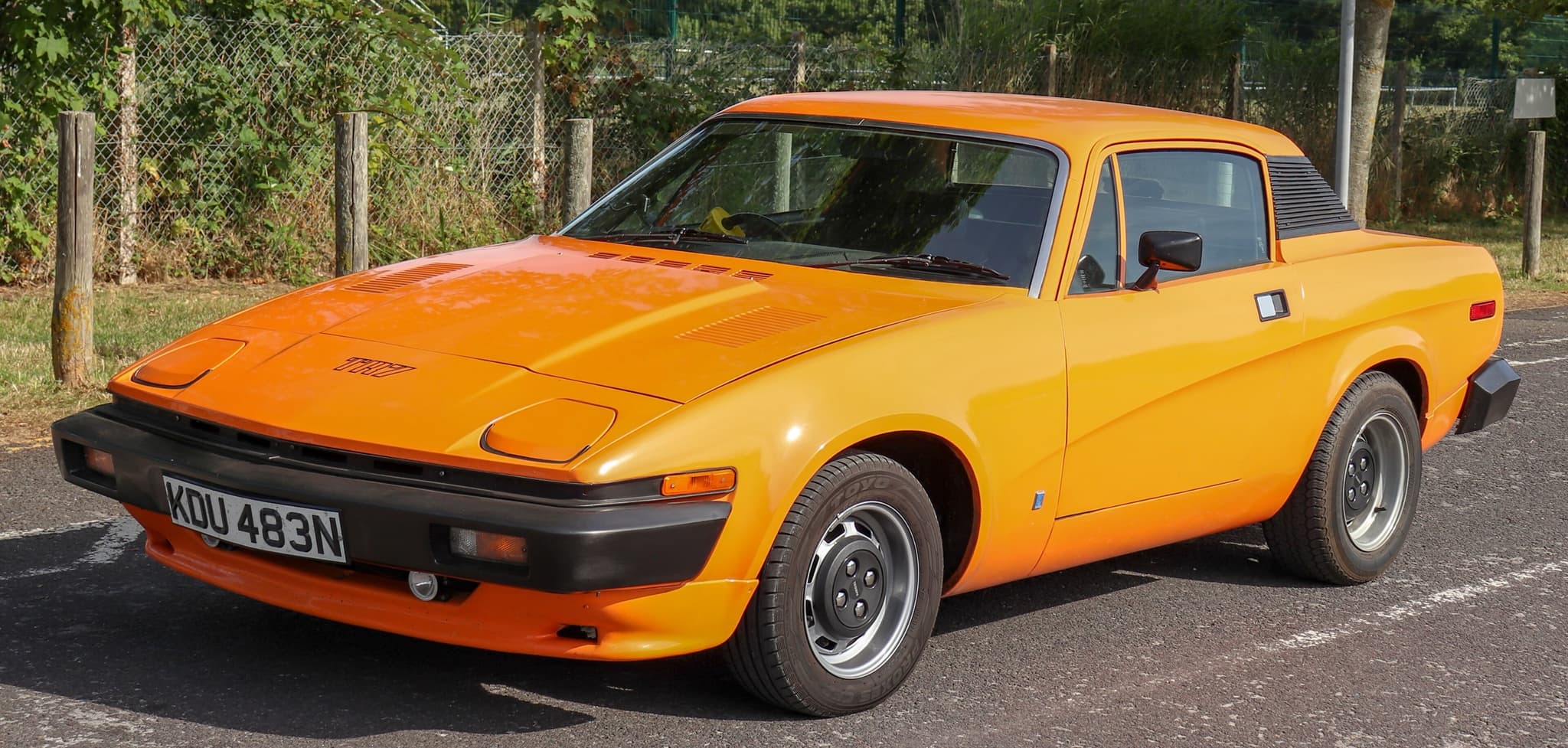
Coupe
1977–1980 · 3528 cc
about 150 built or about 400 or 410 or 160
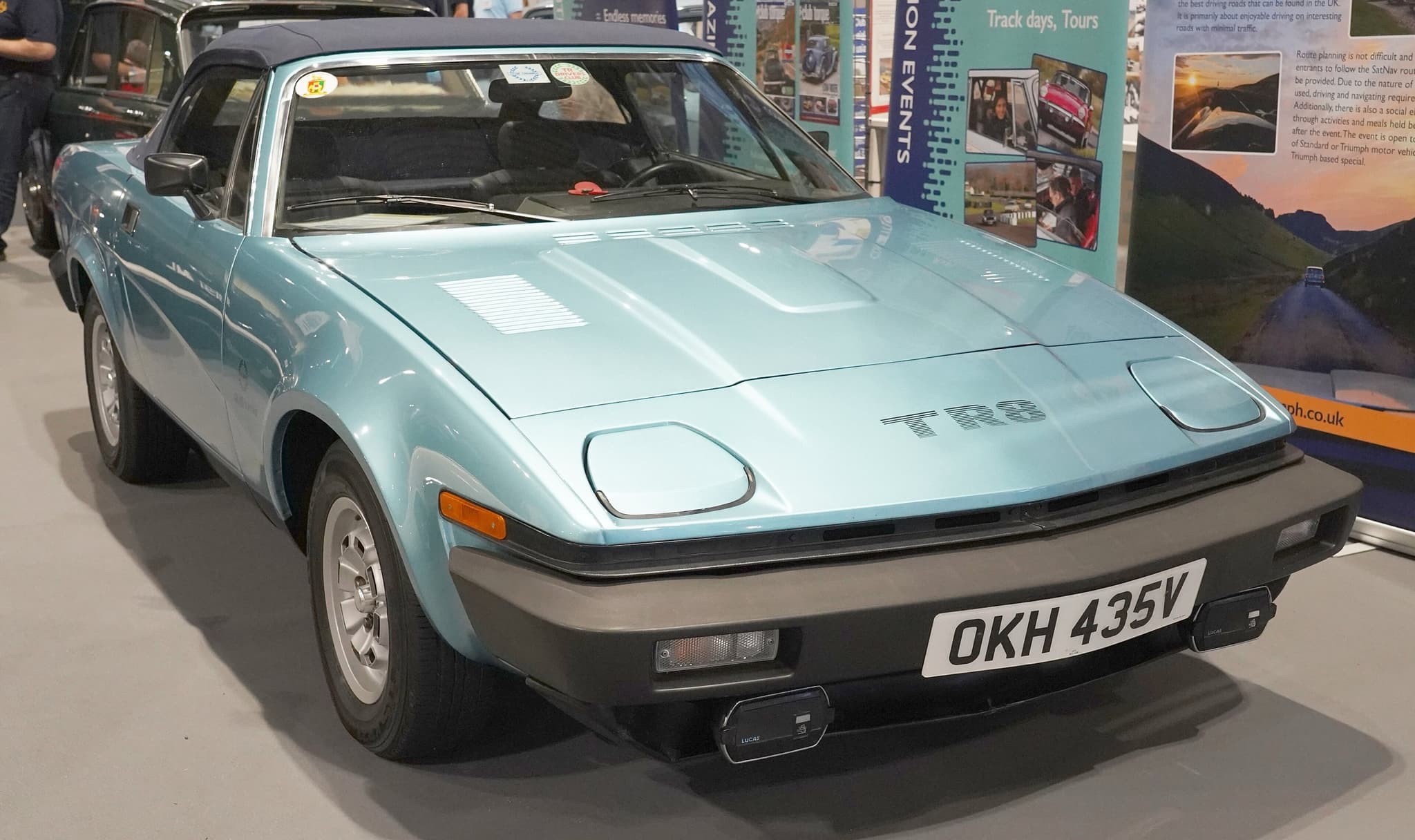
Convertible
1979–1981
UK RHD
1980–1981 · 3528 cc
22 built
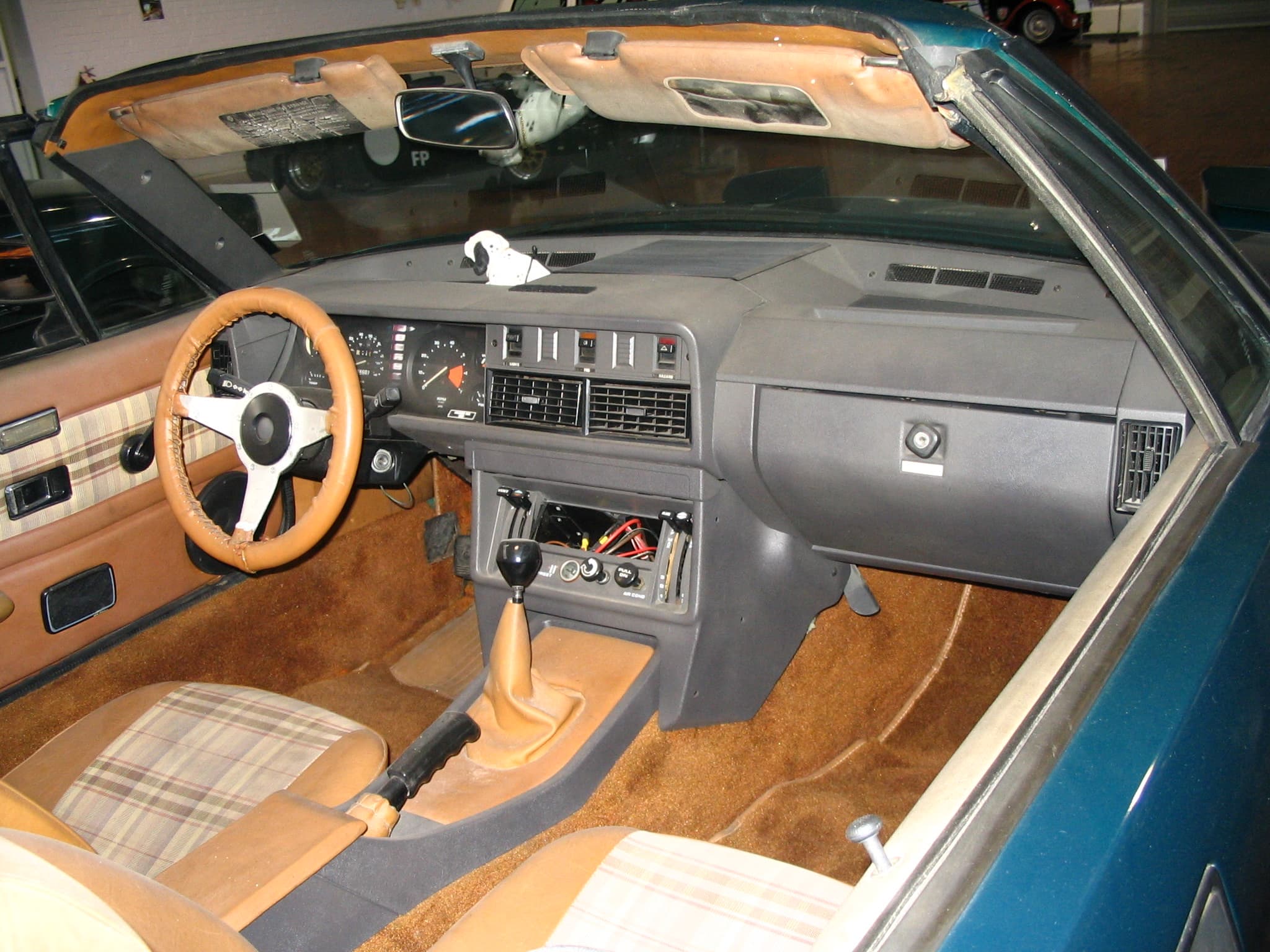
Pictures, top to bottom: Vauxford, CC BY-SA 4.0; kitmasterbloke, CC BY 4.0; kitmasterbloke, CC BY 2.0.
Sources
Sources are given as plain text; their addresses are on the sources page.
- Primarymade at the time, by the maker or by people who were there
- Referenceserious later work: clubs, specialists, magazines, books
- Uncheckedencyclopaedias and enthusiast sites: cited beside a good source, named in the sentence, or marked Unchecked
- Paul Towle and Rex Holford (update) and Mark Elbers (update), "TR7 & TR8 Identification & Production Data Explained", TR Drivers Club, 1987, updated (© 2016), Speke, Canley and Solihull sections; prefixes; ACN, TCN, TCV, TP and SAT sections; Canley's series from October 1979; the UK prefixes; coupé note: no 1979 model-year sales mentioned; the SAT VIN from May 1981; BL production table (b) and its note; "should almost certainly be Convertibles"; specification letters; the SAT VIN from May 1981; K and J; Speke section "ACN". Reference
- Aaron Severson, "Way of the Wedge: The Triumph TR7 and TR8", Ate Up With Motor, 5 Feb 2012, pp. 1–5, p. 4, "all or nearly all were convertibles"; the three plants. Reference
- Road & Track, "Triumph TR8: Good news from the other side" (road test), Jun 1980, pp. 76–79, p. 77, the two engines of 1980; p. 76, the bonnet bulge added late in the 1979 model year; p. 77, "injection is expensive"; the coupé not offered in California; data panel, the speedometer; p. 76, the metallic colours; the plaid inserts; the wheel; June 1980, data panel. Primary
- James TenCate, "Production Numbers – A Detective Story", TR Driver (TR Drivers Club), 2012 no. 2, para. 3, the 1981 cars injected; the UK cars' carburettors; para. 3, the 1981 cars injected; 15E engines, "the handful supplied with automatic transmission"; para. 3; conclusion, the injected cars from the engine numbers and the Lucas order; para. 3, every 1981 car outside the UK injected; para 3. Reference
- triumphtr8.com, "Right hand drive TR8 Home Market UK" and "TR8 RHD Production Story", modified 23 May 2026, carburettors on the UK cars; the UK cars, April 1980 to March 1981; "22 - the Correct Figure". Reference
- Chris Cowin, "History: Exporting British cars to Canada – Part Two: The British Leyland Years", AROnline, 19 Aug 2025, 1982 models advertised; the TR8 and Rover 3500 in Canada, early 1980. Reference
- Rex Holford, "A Brief History of the TR8", TR Drivers Club, X840, X843, X858, X859; batch table. Reference
- triumphtr8.com, Variant pages (group): "FHC TR8 (ACN) 1977", "FHC TR8 (TCN) 1978–1979", "TR8 (TCV) 1979 DHC", "TR8 (TP) 1980", "DHC TR8 (SAT) 1981/82", the ACN, TCN, TCV, TP and SAT pages; TCN page, the Austin Rover letter; TCN page. Reference
- Michael L. Cook, "1981 Triumph TR8: Fast and Last", Special Interest Autos, no. 156, Nov–Dec 1996, pp. 10–17, p. 13, the Speke coupés, most of them automatics; p. 13, the 1978 company cars; p. 10, the 1981 cloth; p. 14, the 1981 panel, automatic "N/A on 1981 models"; p. 10, the 1981 cloth. Reference
- tr8.com, "The 1982 Model Year TR7's & 8's", summary (2012 archive copy). Unchecked
- triumphtr8.com, "European Spec LHD TR8's", 27 Dec 2025, 1980 and 1981 personal-export cars; personal-export cars: no catalysts, leaded fuel, the filler neck. Reference
- triumphtr8.com, "TR8's Genuine Factory cars: History & Authentication" and "Is it a genuine TR8?", 6 Jun 2026, engine-number prefixes 10E to 21E; the British cars' compression; the chassis plate on the turret; the steering wheel, "made by Moto Lita France"; velour and square locks on 1981 cars. Reference
- Triumph Wedge Owners Association, Document pages (group): "TR8", "Memos", "Brochures", TSB indexes, "Deciphering the Wedge", "Component Serial Numbers", "TR8 Cooling Fan System", "TR8 ECU", Component Serial Numbers: TR8 engine prefixes; "Deciphering the Wedge", the 1980 row. Reference
- Michael Lamm, "1st Drive in the Triumph TR8", British Car, Feb–Mar 1999, pp. 46–48, p. 48, dealerships in May 1980; p. 47, Herbert on California and Laredo, as recalled. Reference
- triumphtr8.com, "Production Figures for the TR8", 5 Jan 2026, production table. Reference
- Jaguar Rover Triumph Inc. (Leonia, N.J.), Triumph TR8 (sales brochure), USA, printed 4/80, 1980, specification panel: carburettors, "California specifications, when different, are noted in brackets"; bumpers and spoiler; 4/80 brochure, Engine. Primary
- California Air Resources Board (via the Triumph Wedge Owners Association), California Air Resources Board executive orders A-5-47 (1979 model year), A-5-49 (1980) and A-220-5 (1981), with supplemental data sheets, 22 Feb 1979; 18 Mar 1980; Mar 1981, A-5-47, 22 February 1979; A-5-49, 18 March 1980; A-220-5, 1981. Primary
- Lancaster Insurance, "The Triumph TR8 remembered", 12 May 2022, the fuel systems reversed. Unchecked
- Don Sherman, "Triumph TR8" (road test), Car and Driver, Aug 1980, pp. 36–40, p. 38, the 49-state carburettors. Primary
- Fred M. H. Gregory, "TR8 V-8: A mighty Triumph" (road test), with the sidebar "A String of Triumphs", Motor Trend, Jun 1980, data: carburettors and the FI version; the steering wheel. Primary
- Walt Woron, "1980 Triumph TR8 Convertible: RT's Selection for 'Best New Sports Car of 1980'", Road Test (US), Jul 1980, pp. 16, 83–86, data box p. 86, f.i. and carbs; p. 83, the grey dashboard. Primary
- "C.R.", "The Triumph TR7 Drophead" ("Sunshine Seven"), Motor Sport, Apr 1980, p. 35, p. 35, "at least a year". Primary
- British Leyland Motors Inc. / Jaguar Rover Triumph (via triumphtr8.com), TR8 documents (group): handbooks AKM4335 and AKM4779, workshop and injection guides, parts books, and two sales brochures, the early US sales brochure, printed "9/77": colours and trim. Primary
- triumphtr8.com, Pages (group): "TR8 VIN/CHASSIS", "TR8 Paint Codes", "TR8 trim codes", "TR8 Documents", "TR8 Adverts", "TR8 Clubs", "TR8 Efi – Injection system and sensors", "WL9 Camshaft", "Leyland Special Tuning", "TR8 FIA RAC", "TR8 Auto Choke", "TR8 Badges where do they go?", parts pages, posts "RHD TR8 UK SPEC" and "Round Britain Reliability Run 2023", TR8 Paint Codes; TR8 trim codes. Reference