Triumph TR8 Engine
The Rover V8: an aluminium engine General Motors designed for its compact cars of the early 1960s, taken on by Rover in 1965 and shared by the TR8 with the Rover SD1. How it was made for America, with carburettors or injection, and how to read its numbers.
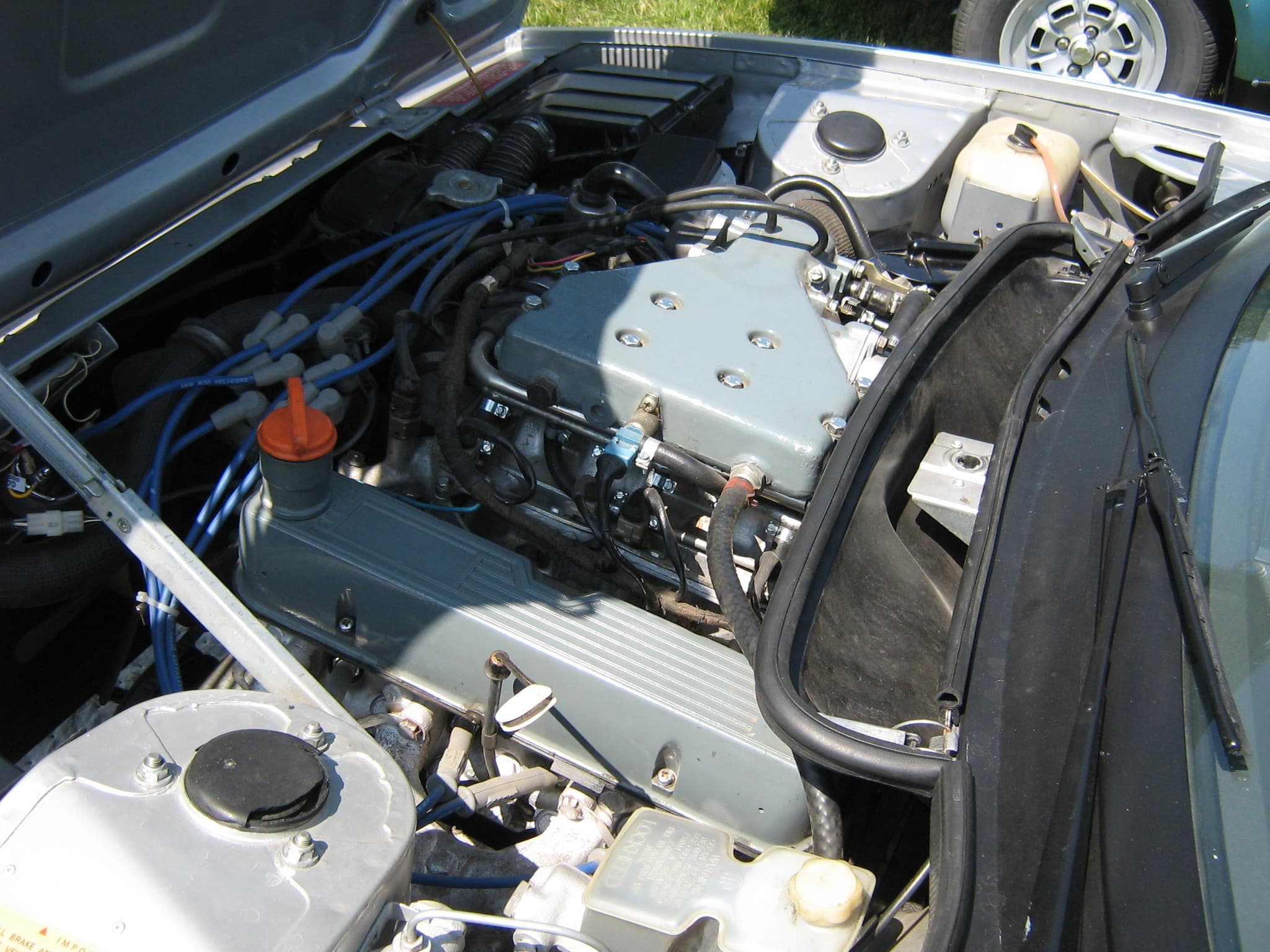
The TR8's engine was older than the car. It was an aluminium V8 that General Motors had designed for its compact cars in the early 1960s and then given up, and that Rover had built since. It came with the Rover SD1 3500's five-speed gearbox (transmission) and axle, as one driveline. Motor Trend, testing the TR8 in 1980, saw nothing wrong in its age:
Never mind that GM saw fit to pension out this same compact engine in the Sixties. It was good then, and it's better now.
From Buick to Rover
Road & Track explained in 1980 that the TR8's bore and stroke were just as they had been when Buick built the V8 for its Special and for Oldsmobile's F-85, in the early 1960s; Road Test dated it to the Buick of 1963. General Motors dropped it, and Rover took it on: "Leyland finagled the rights-to-produce out of GM for an undisclosed price in 1965," Car and Driver wrote. By the time the TR8 was built it was Rover's engine, in the SD1 saloon (sedan), and Triumph's own V8, from the Stag, had not been approved for further production; the history tells how the TR8 came to wait for it.
The TR Register lists the larger sizes it grew to, 3.9, 4.0, 4.2 and 4.6 litres, and an Australian version of 4.4 litres with a longer stroke and a taller block.source 1source 4source 5source 6source 7
The TR8's version
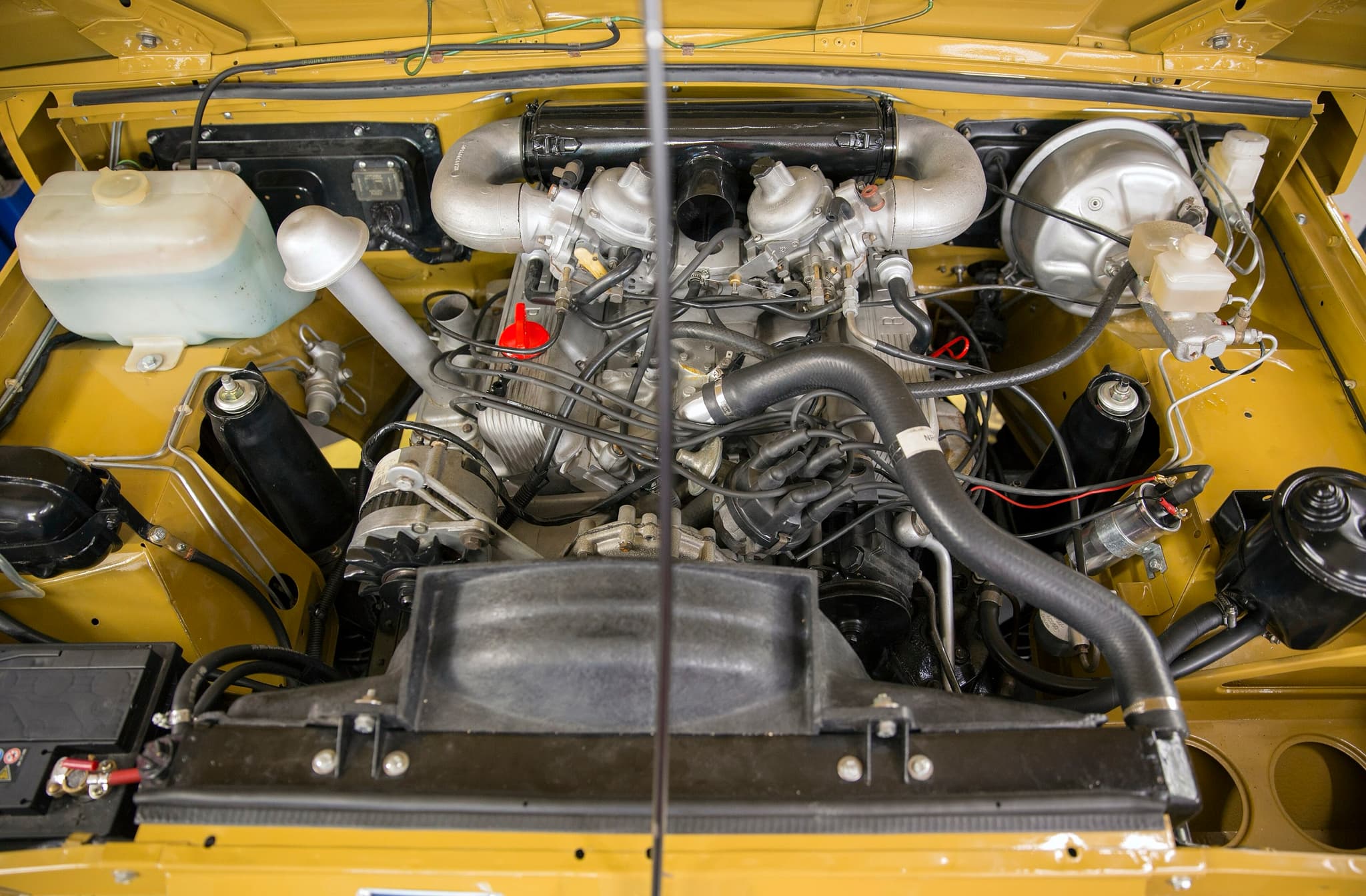
Jaguar Rover Triumph's brochure of 1980 describes a 90° V8 with overhead valves, an aluminium block with cast-iron dry liners and a crankshaft in five main bearings, and Motor Trend adds hydraulic valve lifters. Its ignition was electronic, with its amplifier inside the distributor, a known weak point that the buyers guide explains. On most cars the coil sits above the radiator, though triumphtr8.com finds the SD1's ignition, on the inner wing (inner fender), on some late and personal-export cars.
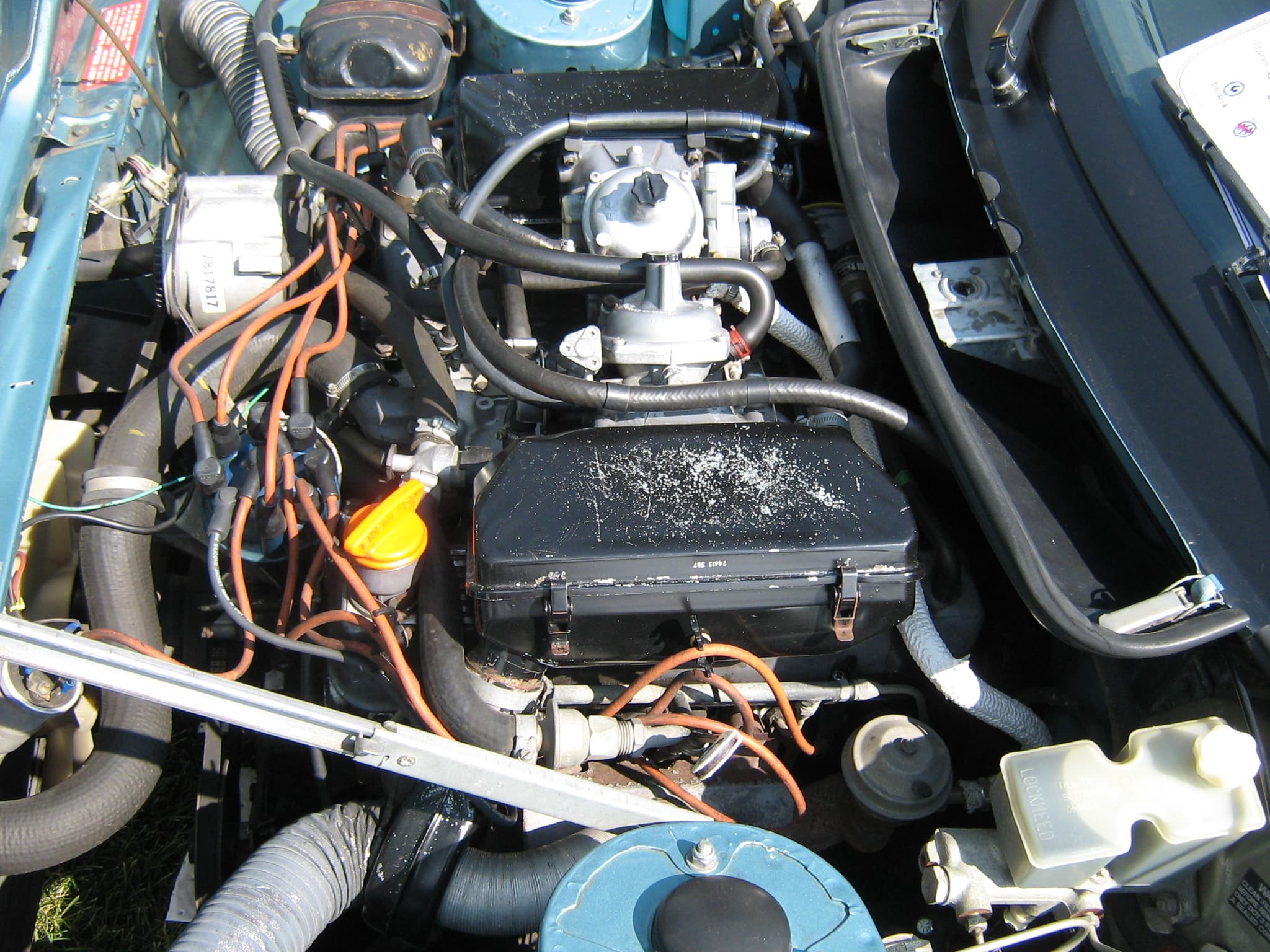
For America it came in two forms. The 49-state engine of the 1980 model year used a pair of Zenith-Stromberg carburettors, under airboxes made for the TR8 alone. California's had Lucas/Bosch L-Jetronic injection: a Bosch air-flow meter, injectors, a cold-start injector, a thermo-time switch and an auxiliary air valve, run by a Lucas control unit, with a three-way catalyst and an oxygen sensor in the exhaust. Michael Lamm noticed at the launch that the TR8's injection plenum faced the passenger's side, where the Rover 3500's faced the driver's. Every North American engine of the 1981 model year was injected, and James TenCate traces the number of injected TR8s, the California cars of 1980 among them, to Canley's first order with Lucas for the injection systems. Many TR8s had two electric fans as well as the engine-driven one.
The testers liked the sound as much as the pull. Road & Track heard "a light, faraway burble" at start-up, and Motor Trend wrote that "Just the way it sounds is enough to make you want to head for the nearest stoplight to lay in ambush for some unsuspecting Porsche". The specifications give the ratings, which are disputed for the injected engine.source 8source 2source 1source 9source 10source 11source 12source 6source 13source 14
Engine numbers
Each TR8 engine number begins with a prefix ending in E that gives its market, its fuel system and its gearbox: 10E to 15E for the American engines, from the 49-state carburettor engine to the injected one, and 20E or 21E for the British cars. Many test and development engines carry 13E, and some EXP. Identification sets out every prefix, and explains why an engine number alone proves nothing about the car.source 15source 10
BL Motorsport and the WL9 camshaft
For the British TR8, BL Motorsport at Abingdon tried a different engine and chassis on the development car NWK 988W in 1980. Richard Hurdwell's memo of 16 December describes the engine work: SD1 pistons to raise the compression, a new camshaft, and a carburettor needle to suit it:
Standard camshaft replaced by 'WL9' Motorsport camshaft and valve spring assemblies.
According to triumphtr8.com, citing John Davenport, BL Motorsport's director, the WL9 camshaft was developed by the competition department and fitted to about 20 company cars, and was later homologated for the racing Rover Vitesse, but it never went into a production engine. The British TR8 itself was dropped before it went on sale.source 16source 9
In competition
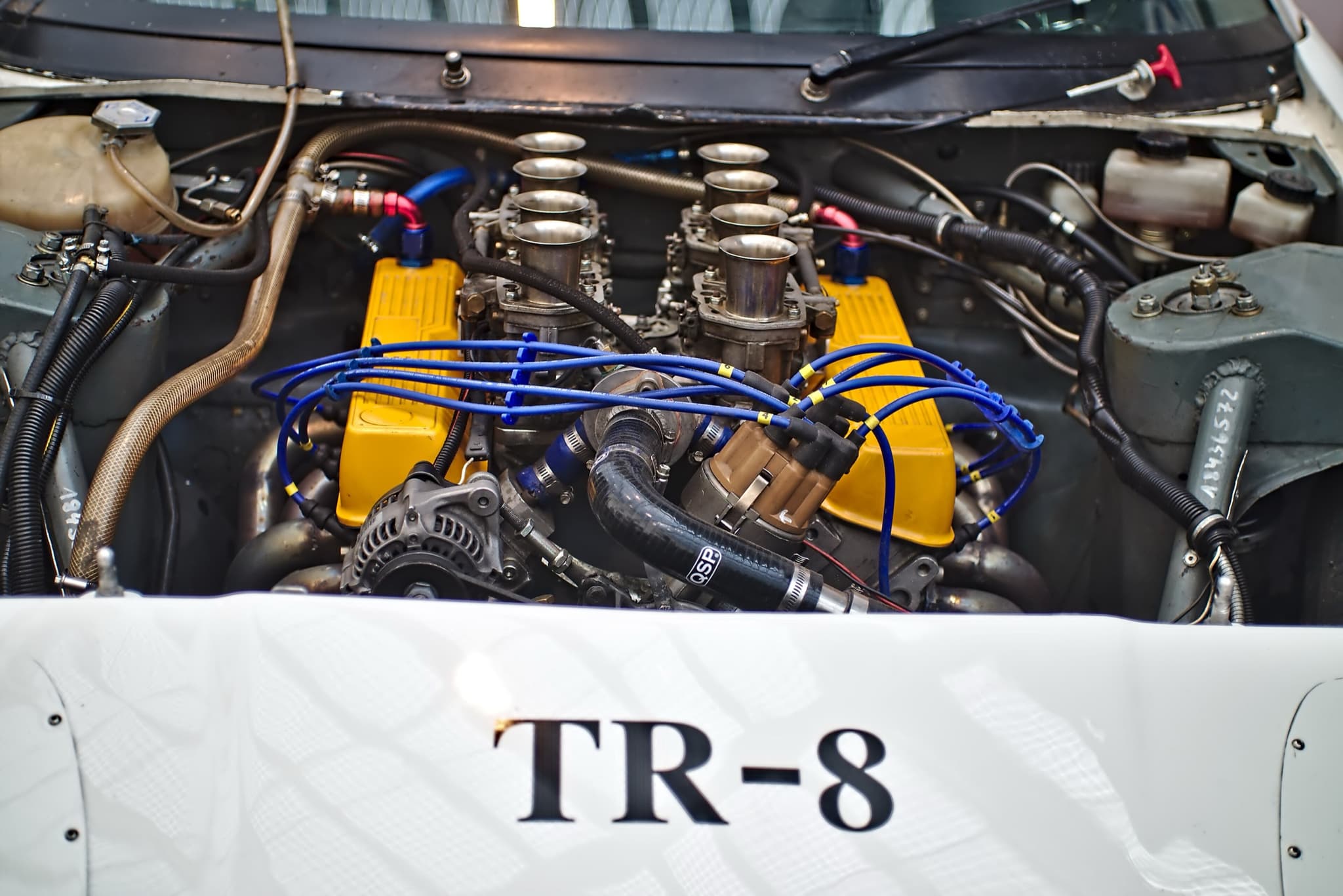
Group 44's TR8 won its class in its first race, in 1979, and Ken Slagle took the SCCA's C Production title in 1981; racing and Group 44's TR8s give the results. The works rally cars of BL Motorsport, TR7 V8s on the TR8's recognition, ran Rover V8s too, and their story belongs to the TR7.source 17source 6source 18
Sources
Sources are given as plain text; their addresses are on the sources page.
- Primarymade at the time, by the maker or by people who were there
- Referenceserious later work: clubs, specialists, magazines, books
- Databaseresults and listings, entry by entry
- Road & Track, "Triumph TR8: Good news from the other side" (road test), Jun 1980, pp. 76–79, p. 77, the engine's origins; p. 77, the Buick Special and Oldsmobile F-85; p. 77, the injection, its catalyst and oxygen sensor; the burble; the fans. Primary
- Fred M. H. Gregory, "TR8 V-8: A mighty Triumph" (road test), with the sidebar "A String of Triumphs", Motor Trend, Jun 1980, "Never mind that GM saw fit to pension out this same compact engine"; hydraulic valve lifters; the sound. Primary
- John Miles, "Miles Behind the Wheel: America's TR8", Autocar, 1979 (May, according to triumphtr8.com), p. 2, the SD1's engine, gearbox and axle. Primary
- Don Sherman, "Triumph TR8" (road test), Car and Driver, Aug 1980, pp. 36–40, p. 38, the rights bought in 1965. Primary
- Walt Woron, "1980 Triumph TR8 Convertible: RT's Selection for 'Best New Sports Car of 1980'", Road Test (US), Jul 1980, pp. 16, 83–86, p. 83, the 1963 Buick. Primary
- Michael L. Cook, "1981 Triumph TR8: Fast and Last", Special Interest Autos, no. 156, Nov–Dec 1996, pp. 10–17, p. 12, the Stag's V8 and Rover's supply; p. 17, the ignition amplifier; p. 13, Group 44 and Slagle. Reference
- Malcolm Paris (compiler), "Triumph TR7 / TR7 V8 and TR8 Buyers Guide", TR Register, FAQ: the Rover V8's later sizes. Reference
- Jaguar Rover Triumph Inc. (Leonia, N.J.), Triumph TR8 (sales brochure), USA, printed 4/80, 1980, Engine: construction, carburettors, ignition. Primary
- triumphtr8.com, Pages (group): "TR8 VIN/CHASSIS", "TR8 Paint Codes", "TR8 trim codes", "TR8 Documents", "TR8 Adverts", "TR8 Clubs", "TR8 Efi – Injection system and sensors", "WL9 Camshaft", "Leyland Special Tuning", "TR8 FIA RAC", "TR8 Auto Choke", "TR8 Badges where do they go?", parts pages, posts "RHD TR8 UK SPEC" and "Round Britain Reliability Run 2023", TR8 Efi: the parts; the carburettor airboxes; WL9 Camshaft, citing John Davenport. Reference
- Triumph Wedge Owners Association, Document pages (group): "TR8", "Memos", "Brochures", TSB indexes, "Deciphering the Wedge", "Component Serial Numbers", "TR8 Cooling Fan System", "TR8 ECU", "TR8 ECU"; "TR8 Cooling Fan System"; Component Serial Numbers. Reference
- Michael Lamm, "1st Drive in the Triumph TR8", British Car, Feb–Mar 1999, pp. 46–48, p. 47, the plenum's side. Reference
- James TenCate, "Production Numbers – A Detective Story", TR Driver (TR Drivers Club), 2012 no. 2, para. 5, the order for injection systems. Reference
- triumphtr8.com, "Rover V8", 12 Aug 2026, the coil; SD1-type ignition. Reference
- triumphtr8.com, "European Spec LHD TR8's", 27 Dec 2025, SD1-type ignition on personal-export cars. Reference
- triumphtr8.com, "TR8's Genuine Factory cars: History & Authentication" and "Is it a genuine TR8?", 6 Jun 2026, engine numbers. Reference
- R. Hurdwell (BL Motorsport, Abingdon), "TR8 Modifications" (memo, 4 pp.), BL Motorsport (via the Triumph Wedge Owners Association), 16 Dec 1980, items 1–3: the pistons, the camshaft, the carburettor needle. Primary
- racingsportscars.com, "All Results of Triumph TR8" (1979–1999), the TR8's results, 1979–82. Database
- Chris Turner (credited by the club), "The Works Triumph TR7 V8 Rally Cars" and the car pages (group), TR Drivers Club, the works TR7 V8s. Reference