Triumph TR8 VIN Decoder
How to read a TR8's chassis number, from the ACN coupés of 1977 to the 17-character numbers of 1981, with its engine and body numbers, the plates that carry them and what a Heritage Certificate adds. The chassis number is what tells a factory TR8 from a TR7 given a V8.
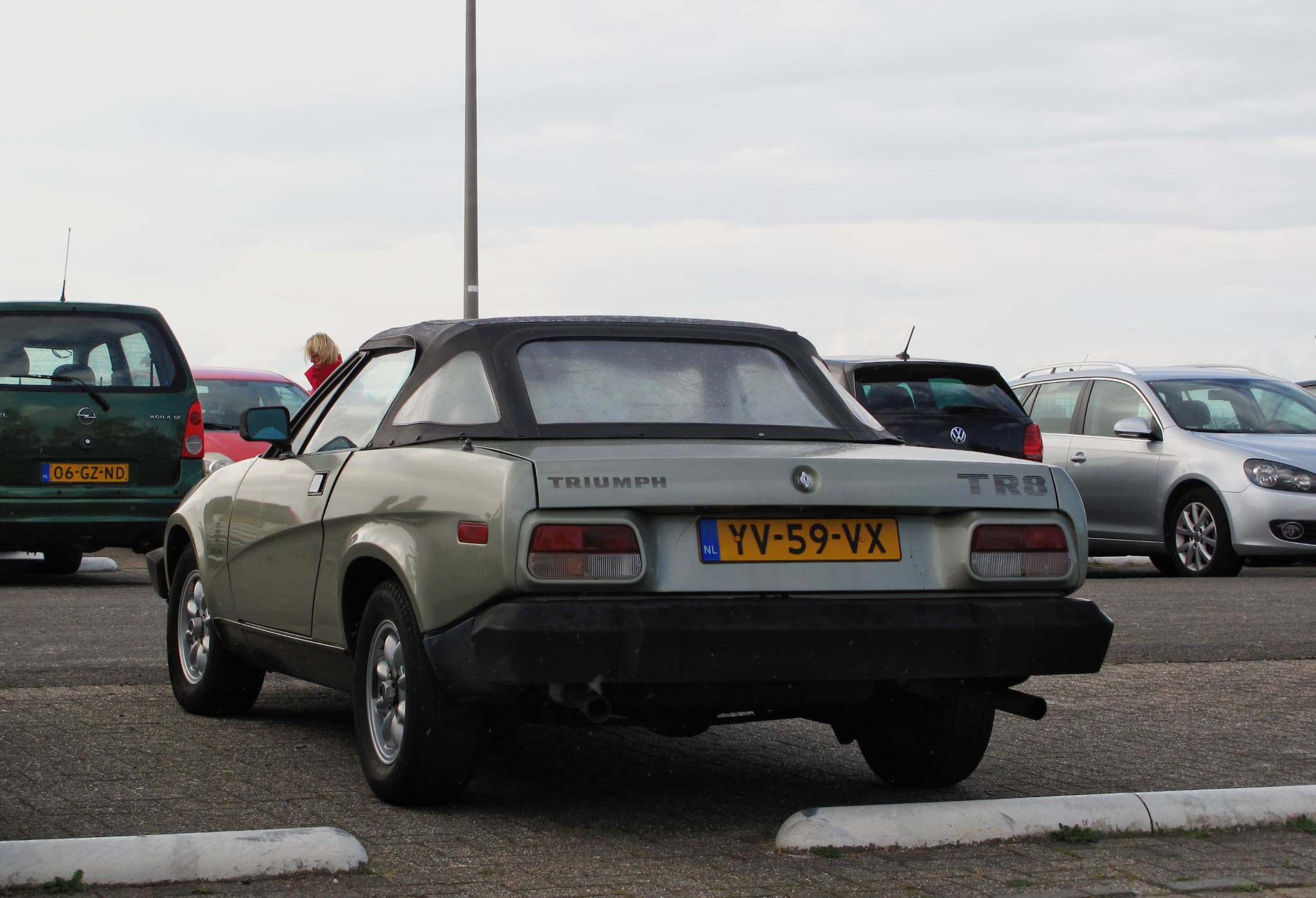
A factory TR8 is told by its chassis number. Badges, decals, a V8 and even the engine number can be fitted to a TR7, and many have been; the number the factory stamped cannot, and a Heritage Certificate from the British Motor Museum confirms what the factory built. This page explains how the TR8's numbers work, from the coupés of 1977 to the 17-character vehicle identification numbers (VINs) of 1981. The two main guides to them are the TR Drivers Club's, first written in 1987 and updated since, and triumphtr8.com's, which follows it and adds evidence from the build records. The production tally at the foot of the page sets out the main counts of TR8s, each with its source.source 1source 2source 3
Where the numbers are
| Number | Where to find it |
|---|---|
| Vehicle data plate, North American cars | On the inside edge of the driver's door, in the door shut |
| VIN plate, North American cars | A silver plate, read through the windscreen (windshield) |
| Vehicle data plate, British cars | On the front suspension turret, in the engine bay |
| Engine number | On the block, down by the dipstick |
| Paint and trim codes | On the door plate |
Chassis numbers before the VIN, 1977–79
Before October 1979 a chassis number began with three letters: the plant, C for the TR7 and TR8 range, and a letter for the specification.
| Prefix | Meaning |
|---|---|
| ACN | A coupé built at Speke (A), probably for North America (N), as the TR Drivers Club reads it: the pre-production TR8s of 1977 |
| ACT | A prototype convertible, built at Speke in 1978 and given a V8 at Canley late that year |
| TCN | A TR8 coupé built at Canley (T) for the 1978 and 1979 model years |
| TCV | A TR8 convertible built at Canley for North America, from 1979 |
The TR7's letters are different: L, G and W for its coupés, H for the 1977 Sprint coupés and, at Canley, T for its convertible. Suffixes after the number add detail: U for North America, L for other left-hand-drive cars, F for a five-speed gearbox (transmission), A for an automatic, C for exhaust control and M for Canada. The Canley TR8 numbers have six figures: TCN 150001 to 150198 for the 1978 model year and 160001 to 160142 for the 1979 model year, most of them probably never used, the TR Drivers Club thinks, and TCV from 200001. The Speke coupés' range is printed in two ways, and the coupé's page gives both.source 1source 7
The VIN, from October 1979
From October 1979 the TR7 and TR8 took a 14-character number, though a few TCV convertibles, the TR Drivers Club notes, kept the old prefix with a serial in the new series. Its first eight characters describe the car and the last six are its serial:
| Place | Meaning |
|---|---|
| 1 and 2 | TP: Triumph, the TR7 and TR8 range |
| 3 | The market: A for Britain or Europe, V for the 49 states, Z for California, L for Canada, K for Australia, J for Japan (if it was used) |
| 4 | The body: E for a coupé, D for a convertible |
| 5 | The engine: V for the TR8's V8, J for the TR7's four |
| 6 | Steering and gearbox: 7 right-hand drive, manual; 3 right-hand drive, automatic; 8 left-hand drive, manual; 4 left-hand drive, automatic |
| 7 | The model year: A for 1980; B for 1981 and C for 1982, on North American cars only |
| 8 | The plant: T for Canley, A for Solihull |
| 9 to 14 | The serial number |
The serials ran in one series for every TR7 and TR8. Canley used 200001 to 215080, from October 1979 to August 1980. Solihull used 400001 to 401918 for the 1980 model year, from April to September 1980, and 402027 to 405636 for the 1981 model year, to May 1981; 402001 to 402026 were built at Canley in May and June 1980.
From May 1981, as new American and Canadian rules required, the North American cars had a 17-character number, with three letters in front, the engine and body shown by digits, and a check digit:
The check digit is worked out by turning each character into a number, multiplying them by 8, 7, 6, 5, 4, 3, 2 and 10 for the first eight places and by 9 down to 2 for the last eight, adding the results and dividing by 11: the remainder is the check digit, written X when it is 10. The SAT cars took serials from 406001, and the TR Drivers Club gives 408534 as the last. triumphtr8.com, which lists the factory's numbers, is blunt about a car without one:
If the car you are looking at doesn't have one of the above chassis numbers then 99.99% it isn't.
SATPV458XBA408565
- SATThe maker's world code: S for Europe, A for Britain, T for Triumph
- PThe range: the TR7 and TR8
- VThe market: the 49 states; Z is California, L Canada
- 4The body: a convertible; 5 is a coupé
- 5The engine: the V8; 1 is the TR7's four
- 8Left-hand drive with the manual gearbox; 4 is an automatic
- XThe check digit
- BThe model year: 1981
- AThe plant: Solihull
- 408565The serial number
The right-hand-drive British cars
The British pilot cars have numbers of their own: TPADV7A for a manual car and TPADV3A for an automatic, with T or A after them for Canley or Solihull. The second batch built on the line, and one methods-build car, are stamped TPVDA7AA, with the V and the A transposed, on their build records as well as on the cars, which triumphtr8.com calls a reliable way of picking out that batch. One genuine car, the automatic methods-build car 402290, carries a TR7 number and a TR7 plate, and Heritage records it as a right-hand-drive TR8.
The plates vary in the same way. The British TR8 plate, part TKC6764, gives a gross weight of 1,420 kg with the weights on the right, where the TR7's, TKC4542, gives 1,340 kg on the left. Reproductions of the TR8 plate are sold, and triumphtr8.com notes how they differ: on an original the first 0 of the figures "031013" lines up with the gap under "BL", towards the left, while a reproduction has those figures in the middle and larger lettering for the paint and trim codes. The Triumph Wedge Owners Association leaves the details of the British and prototype cars out of its own decoding pages:
It was felt that there is a significant risk that some unscrupulous individuals might take the information presented here, fabricate VIN numbers (close to the originals), and attach them to upgraded TR7-V8s thus passing these new cars off as real TR8s.
Engine, gearbox and axle numbers
A TR8 engine number has a two-figure prefix ending in E:
| Prefix | Engine |
|---|---|
| 10E | 49 states, carburettors, manual; also the first two British cars and some test cars |
| 11E | 49 states, carburettors, automatic |
| 12E | California, carburettors, manual |
| 13E | California, carburettors, automatic; also many test and development cars |
| 14E | Fuel injection, manual |
| 15E | Fuel injection, automatic |
| 20E | British cars, carburettors, manual |
| 21E | British cars, carburettors, automatic |
Test and development engines may carry EXP instead. triumphtr8.com's rule of thumb is that "Any other letter after the number other than E almost certainly means it's not factory". The 12E and 13E engines fit the carburettor TR8 that the California Air Resources Board certified for the 1979 model year. The highest injected engine number that James TenCate of the Triumph Wedge Owners Association traced, 14E00799, is, with Lucas's order for injection systems, the basis of his estimate of how many injected TR8s were built. The five-speed gearbox's number begins 15A, the Borg-Warner automatic's 051N and the axle's CK. An engine number by itself proves nothing about the car it sits in, since a TR8 engine may have come from a scrapped car.source 2source 10source 6source 11source 12
Body numbers
The body shell carries its own number, which shows the body type and the steering side.
| Body number | Meaning |
|---|---|
| Ending CK | A left-hand-drive coupé |
| Ending CG | A right-hand-drive coupé |
| BAP or CGP | A left-hand-drive convertible |
| BBP | A right-hand-drive convertible, used for the British quality-build car and the experimental cars |
| CHP 100 series | Left-hand drive, seen on a few Canley coupés |
| CHP 300 series | A right-hand-drive TR8 shell: all of the British pilot cars but the first |
Signs that support a factory car
None of these proves a TR8, since each can be fitted to a TR7, but a car that lacks several deserves questions.
| Sign | On a factory TR8 |
|---|---|
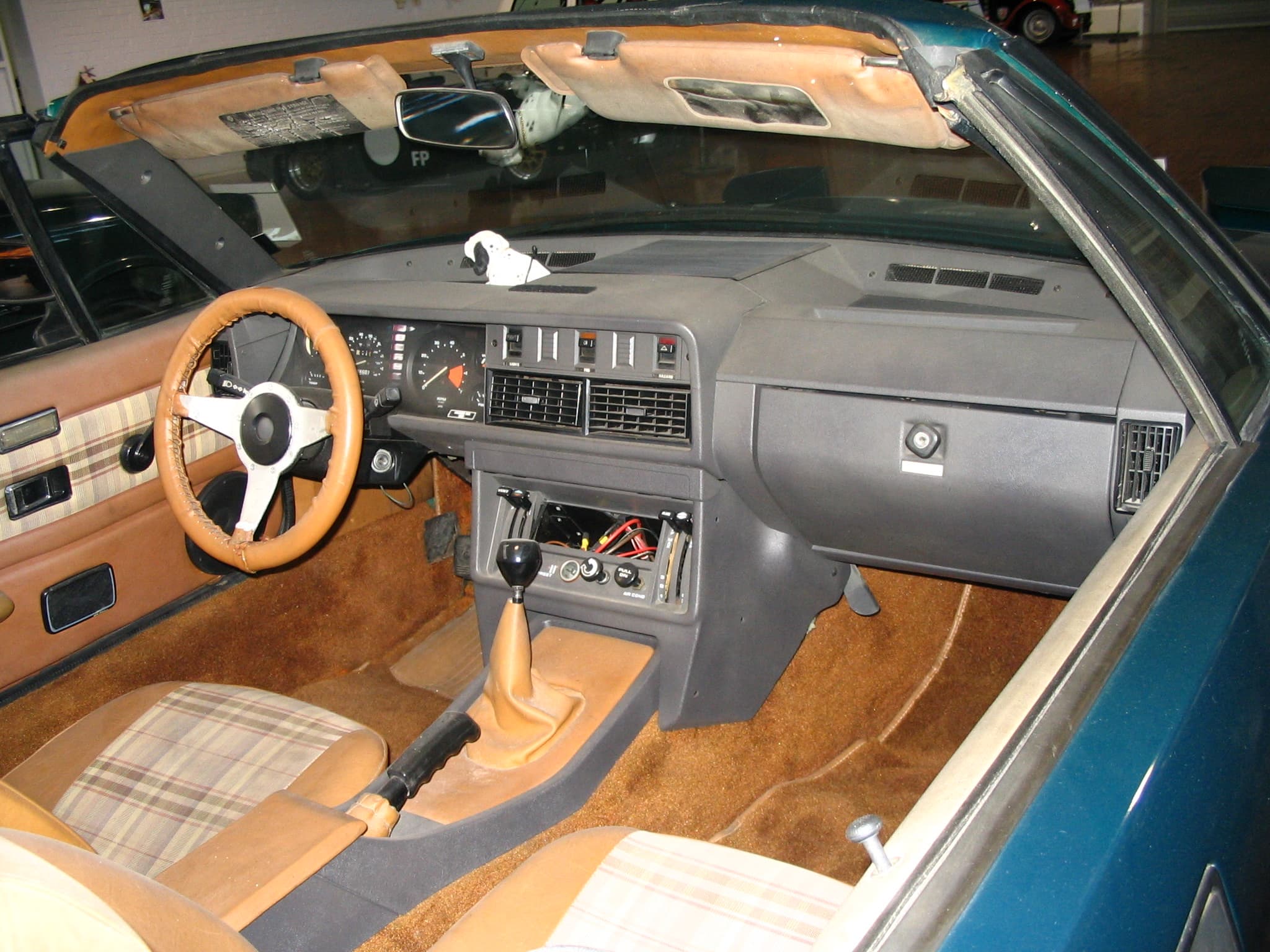
| Steering | A power-assisted rack, its pipes visible from below; the TR7 had no power steering as standard |
| Rev counter | A lower red line than the TR7's |
| Steering wheel | On the convertible, a small leather-rimmed Moto-Lita wheel with recessed screws; the coupés had the TR7's wheel |
| Inertia switch | Square from 1979–80, round before |
| Brake servo | A + pattern on its face, where a TR7's has an X |
| Front brakes | Solid discs, thicker than the TR7's |
| Exhaust | A tailpipe at each side |
| Fuel system | Two Zenith-Stromberg carburettors with airboxes, or Lucas/Bosch injection; nothing else is original |
| Battery | In the boot, with a metal plate under the carpet guarding its cable |
| Trim | On cars of the 1981 model year, blue or tan velour, square door locks and larger headrests |
Heritage Certificates
The British Motor Museum issues Heritage Certificates from the build records in its archive, giving what the factory recorded of a car's build and despatch. For any car whose number is unusual, whose history is special or whose identity is in doubt, triumphtr8.com treats one as the least that will do. TenCate thought it "pretty cool to have a 'birth certificate' for your car".
A certificate's evidence is the factory's record. A note added to it later is a claim like any other and has to be checked: triumphtr8.com describes a case in which an unverified story was added to a car's certificate and later withdrawn by the museum's archive. The records can mislead in smaller ways too: triumphtr8.com cites a TR7-numbered development car whose certificate says it was despatched to the United States while the test fleet's records keep it in Britain.source 3source 2source 11source 13

What is not proof
triumphtr8.com lists what does not make a car a TR8: a body number alone, which is often what is left when a scrapped car has lost its chassis plate; a chassis number that is invented or wrong; letters from former owners, which are opinion; photocopies of registration documents, which are often altered; badges and trim, which are easily added; and an engine number on its own. Auction descriptions are not proof either, since the auction houses' own terms say they are supplied by the seller and not verified. Stories of factory right-hand-drive conversions, press cars and development prototypes need documents behind them, and the coupé's page and the right-hand-drive page explain why so few have any. A TR7 given a V8 is not a fake, unless it is sold as a TR8; TR7 V8 conversions tells how they were built.source 13source 2
Production
Production: how far the sources agree
- about 150, Coupe, Speke pre-production coupes, Feb-Oct 1977
- Good sources agree.
- 145, Coupe, shipped to US and Canadian BL employees as 1978 company cars
- One good source.
- 204, Coupe, BL's calendar 1979 "TR 8 FHC" (63 home, 141 export)
- One good source.
- about 400, Coupe, all coupes; a TWOA newsletter, via TenCate
- Disputed.
- 410, Coupe, all coupes; an Austin Rover letter, as reported
- Disputed.
- 160, Coupe, Speke 1977-78
- Disputed.
- 2097, Convertible, BL calendar 1980 (9 home, 2,088 export); row labelled "TR 8 FHC (DHC?)", convertibles
- One good source.
- 414, Convertible, BL calendar 1981 (9 home, 405 export)
- One good source.
- 2088, Convertible, US convertibles, batch table
- One good source.
- 1954, Convertible, 1979-80 convertibles (plus 13 UK DHC in 1980)
- One good source.
- about 800, Fuel Injection, all injected TR8s; Lucas order of 800 systems, engine numbers to 14E00799
- One good source.
- 22, UK RHD, Home Market RHD cars, from build records and Heritage certificates; plus 3 EXP cars (X921, X923, X925)
- One good source.
- 18, UK RHD, BL's table: 9 home in 1980, 9 in 1981
- One good source.
- 9 + 9, UK RHD, batch table, Solihull 1980 and 1981
- One good source.
- 14, UK RHD, unregistered RHD cars sold at Measham
- One good source.
- 16, UK RHD, unregistered TR8s in the Measham lists (some possibly LHD)
- One good source.
- 2715, TR8, BL's calendar-year table, 1979-81; leaves out pre-production and prototype cars
- One good source.
- 2733, TR8, batch table, provisional
- One good source.
- about 2,750, TR8, by batch and plant
- One good source.
- 2815, TR8, Kimberley's 1981 guide, as quoted by Cook
- Disputed.
- 2634, TR8, shipped to North America; Graham Robson, as given by the magazine's editor
- Disputed.
- 2722, TR8, buyers guide text
- Disputed.
- 2600, TR8, buyers guide facts table
- Disputed.
about 150Coupe, Speke pre-production coupes, Feb-Oct 1977
Paul Towle and Rex Holford (update) and Mark Elbers (update), "TR7 & TR8 Identification & Production Data Explained", TR Drivers Club, 1987, updated (© 2016)source 1
145Coupe, shipped to US and Canadian BL employees as 1978 company cars
Michael L. Cook, "1981 Triumph TR8: Fast and Last", Special Interest Autos, no. 156, Nov–Dec 1996, pp. 10–17source 17
204Coupe, BL's calendar 1979 "TR 8 FHC" (63 home, 141 export)
Paul Towle and Rex Holford (update) and Mark Elbers (update), "TR7 & TR8 Identification & Production Data Explained", TR Drivers Club, 1987, updated (© 2016)source 1
about 400Coupe, all coupes; a TWOA newsletter, via TenCate
James TenCate, "Production Numbers – A Detective Story", TR Driver (TR Drivers Club), 2012 no. 2source 11
410Coupe, all coupes; an Austin Rover letter, as reported
triumphtr8.com, Variant pages (group): "FHC TR8 (ACN) 1977", "FHC TR8 (TCN) 1978–1979", "TR8 (TCV) 1979 DHC", "TR8 (TP) 1980", "DHC TR8 (SAT) 1981/82"source 7
160Coupe, Speke 1977-78
triumphtr8.com, "Production Figures for the TR8", 5 Jan 2026source 18
2097Convertible, BL calendar 1980 (9 home, 2,088 export); row labelled "TR 8 FHC (DHC?)", convertibles
Paul Towle and Rex Holford (update) and Mark Elbers (update), "TR7 & TR8 Identification & Production Data Explained", TR Drivers Club, 1987, updated (© 2016)source 1
414Convertible, BL calendar 1981 (9 home, 405 export)
Paul Towle and Rex Holford (update) and Mark Elbers (update), "TR7 & TR8 Identification & Production Data Explained", TR Drivers Club, 1987, updated (© 2016)source 1
2088Convertible, US convertibles, batch table
Rex Holford, "A Brief History of the TR8", TR Drivers Clubsource 19
1954Convertible, 1979-80 convertibles (plus 13 UK DHC in 1980)
triumphtr8.com, "Production Figures for the TR8", 5 Jan 2026source 18
about 800Fuel Injection, all injected TR8s; Lucas order of 800 systems, engine numbers to 14E00799
James TenCate, "Production Numbers – A Detective Story", TR Driver (TR Drivers Club), 2012 no. 2source 11
22UK RHD, Home Market RHD cars, from build records and Heritage certificates; plus 3 EXP cars (X921, X923, X925)
triumphtr8.com, "Right hand drive TR8 Home Market UK" and "TR8 RHD Production Story", modified 23 May 2026source 9
18UK RHD, BL's table: 9 home in 1980, 9 in 1981
Paul Towle and Rex Holford (update) and Mark Elbers (update), "TR7 & TR8 Identification & Production Data Explained", TR Drivers Club, 1987, updated (© 2016)source 1
9 + 9UK RHD, batch table, Solihull 1980 and 1981
Rex Holford, "A Brief History of the TR8", TR Drivers Clubsource 19
14UK RHD, unregistered RHD cars sold at Measham
triumphtr8.com, "Right hand drive TR8 Home Market UK" and "TR8 RHD Production Story", modified 23 May 2026source 9
16UK RHD, unregistered TR8s in the Measham lists (some possibly LHD)
Canley Classics, "TR7 & TR8 Experimental Records"source 20
2715TR8, BL's calendar-year table, 1979-81; leaves out pre-production and prototype cars
Paul Towle and Rex Holford (update) and Mark Elbers (update), "TR7 & TR8 Identification & Production Data Explained", TR Drivers Club, 1987, updated (© 2016)source 1
2733TR8, batch table, provisional
Rex Holford, "A Brief History of the TR8", TR Drivers Clubsource 19
about 2,750TR8, by batch and plant
triumphtr8.com, "Production Figures for the TR8", 5 Jan 2026source 18
2815TR8, Kimberley's 1981 guide, as quoted by Cook
Michael L. Cook, "1981 Triumph TR8: Fast and Last", Special Interest Autos, no. 156, Nov–Dec 1996, pp. 10–17source 17
2634TR8, shipped to North America; Graham Robson, as given by the magazine's editor
Michael Lamm, "1st Drive in the Triumph TR8", British Car, Feb–Mar 1999, pp. 46–48source 21
2722TR8, buyers guide text
Malcolm Paris (compiler), "Triumph TR7 / TR7 V8 and TR8 Buyers Guide", TR Registersource 22
2600TR8, buyers guide facts table
Malcolm Paris (compiler), "Triumph TR7 / TR7 V8 and TR8 Buyers Guide", TR Registersource 22
Sources
Sources are given as plain text; their addresses are on the sources page.
- Primarymade at the time, by the maker or by people who were there
- Referenceserious later work: clubs, specialists, magazines, books
- Paul Towle and Rex Holford (update) and Mark Elbers (update), "TR7 & TR8 Identification & Production Data Explained", TR Drivers Club, 1987, updated (© 2016), the article as a whole: prefixes, VINs and BL's production table; plate positions; Speke and Canley sections: letters, suffixes and ranges; the TP and SAT systems; serial ranges; the check digit and its worked example; Speke section "ACN"; BL production table (b). Reference
- triumphtr8.com, "TR8's Genuine Factory cars: History & Authentication" and "Is it a genuine TR8?", 6 Jun 2026, "Is it a genuine TR8?"; "TR8's Genuine Factory cars"; the VIN plate in the windscreen; the engine number by the dipstick; part numbers of the plates; "99.99% it isn't"; original and reproduction TKC6764 plates; engine-number list; "Any other letter after the number other than E"; body numbers; "a guide only"; the signs: rack, wheel, inertia switch, servo, battery, cable plate, trim, badges; cars with odd numbers need a certificate; the battery and conversions. Reference
- British Motor Museum (BMIHT), "Heritage Certificates", service description. Primary
- triumphtr8.com, "European Spec LHD TR8's", 27 Dec 2025, second stampings on personal-export cars. Reference
- triumphtr8.com, Pages (group): "TR8 VIN/CHASSIS", "TR8 Paint Codes", "TR8 trim codes", "TR8 Documents", "TR8 Adverts", "TR8 Clubs", "TR8 Efi – Injection system and sensors", "WL9 Camshaft", "Leyland Special Tuning", "TR8 FIA RAC", "TR8 Auto Choke", "TR8 Badges where do they go?", parts pages, posts "RHD TR8 UK SPEC" and "Round Britain Reliability Run 2023", TR8 VIN/Chassis; the servo, AAU7925. Reference
- Triumph Wedge Owners Association, Document pages (group): "TR8", "Memos", "Brochures", TSB indexes, "Deciphering the Wedge", "Component Serial Numbers", "TR8 Cooling Fan System", "TR8 ECU", "Deciphering the Wedge": paint and trim codes on the door plate; "Deciphering the Wedge" (2022): the details withheld; Component Serial Numbers: engine, gearbox and axle prefixes. Reference
- triumphtr8.com, Variant pages (group): "FHC TR8 (ACN) 1977", "FHC TR8 (TCN) 1978–1979", "TR8 (TCV) 1979 DHC", "TR8 (TP) 1980", "DHC TR8 (SAT) 1981/82", FHC TR8 (ACN) 1977; FHC TR8 (TCN); TR8 (TCV) 1979 DHC; TR8 (TP) 1980; DHC TR8 (SAT) 1981/82; TCN page. Reference
- Michael Hart, "Counting TR7 Spiders: A Day at the Gaydon Archive", Triumph Wedge Owners Association, © 2013, Solihull's 1980 model-year build cards. Reference
- triumphtr8.com, "Right hand drive TR8 Home Market UK" and "TR8 RHD Production Story", modified 23 May 2026, production story: the prefixes, the transposed letters, 402290, the plates; CHP 300 and BBP shells on the British cars; "22 - the Correct Figure"; Measham section. Reference
- triumphtr8.com, "Rover V8", 12 Aug 2026, engine numbers 10E–21E; 13E and EXP on test cars. Reference
- James TenCate, "Production Numbers – A Detective Story", TR Driver (TR Drivers Club), 2012 no. 2, 14E00799; the Lucas order; "a 'birth certificate' for your car"; para 3; conclusion. Reference
- California Air Resources Board (via the Triumph Wedge Owners Association), California Air Resources Board executive orders A-5-47 (1979 model year), A-5-49 (1980) and A-220-5 (1981), with supplemental data sheets, 22 Feb 1979; 18 Mar 1980; Mar 1981, A-5-47, the 1979 California carburettor engine. Primary
- triumphtr8.com, Pages (group): "FHC V8's 'TR8 Pre Production'", "TR8s with Creative Histories" and its linked case page, "Triumph TR8 RHD vs LHD: Factory Conversion Myths", "Buying a TR8", "TR8 Test, Development. EXP cars", cars registered on body numbers; a note added to a certificate and withdrawn; a development car's despatch record; "Buying a TR8": what is not proof; auction houses' terms. Reference
- Road & Track, "Triumph TR8: Good news from the other side" (road test), Jun 1980, pp. 76–79, power steering standard; the battery in the trunk. Primary
- John Miles, "Miles Behind the Wheel: America's TR8", Autocar, 1979 (May, according to triumphtr8.com), p. 1, the red line; p. 2, the discs; the twin exhausts. Primary
- Don Sherman, "Triumph TR8" (road test), Car and Driver, Aug 1980, pp. 36–40, data panel, the red line; p. 38, the discs. Primary
- Michael L. Cook, "1981 Triumph TR8: Fast and Last", Special Interest Autos, no. 156, Nov–Dec 1996, pp. 10–17, p. 13; p. 16. Reference
- triumphtr8.com, "Production Figures for the TR8", 5 Jan 2026, production table. Reference
- Rex Holford, "A Brief History of the TR8", TR Drivers Club, batch table. Reference
- Canley Classics, "TR7 & TR8 Experimental Records", BCA Measham section. Primary
- Michael Lamm, "1st Drive in the Triumph TR8", British Car, Feb–Mar 1999, pp. 46–48, p. 48, editor's note. Reference
- Malcolm Paris (compiler), "Triumph TR7 / TR7 V8 and TR8 Buyers Guide", TR Register, text; facts table. Reference